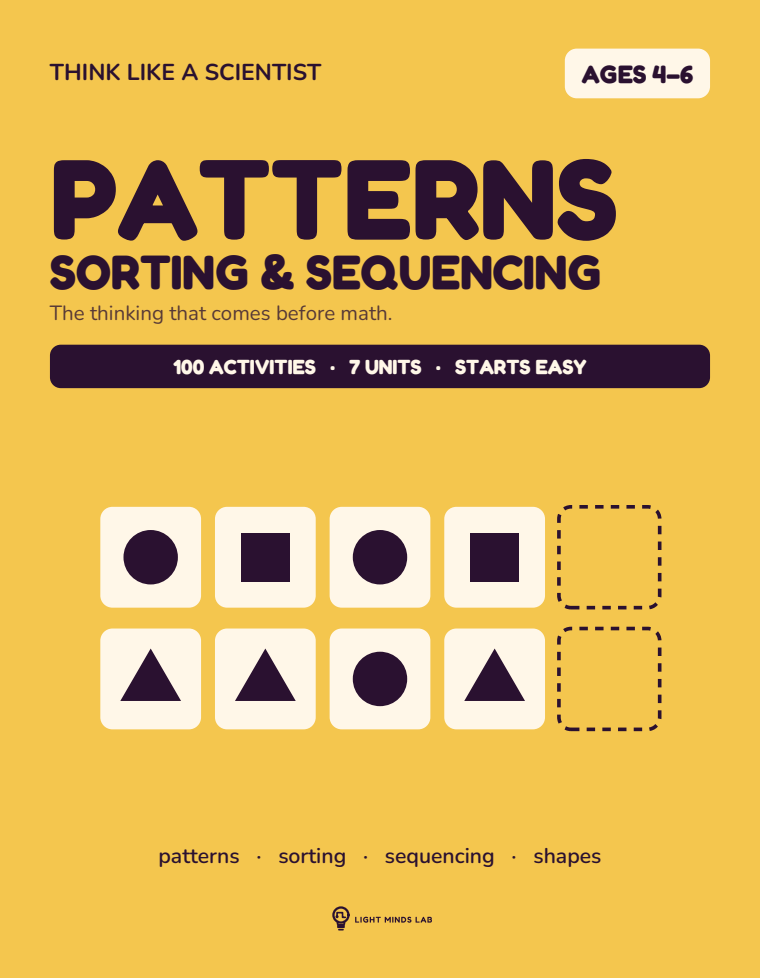
Patterning looks like the softest thing in a preschool math curriculum. It is not. Sorting, seriation and patterning are the algebraic thinking strand of early math: the work of finding structure in a set and describing the rule that generates it. That is what algebra is. The letters come later.
Most pattern worksheets are twelve variations on AB, which leaves the rest of that strand untaught.
The progression
AB. Red, blue, red, blue. The unit of repeat is two items. Nearly every four-year-old gets here.
ABC. Red, blue, yellow, red, blue, yellow. More difficult than it looks, because the child has to hold a three-item unit rather than alternate.
AAB / ABB. Red, red, blue. This is the first difficult step, and the one most books skip. A child working from "it goes one, then the other" has to abandon that idea and find the unit instead. Expect wrong answers here from children who had no trouble with ABC.
AABB. Two and two. Consolidates the unit idea.
Growing patterns. One dot, two dots, three dots. The rule is no longer a repeat. It is a change applied each time. That is the step toward functions, and it is reachable at five or six.
Patterns in other media. The same AB structure in sound, such as clap, stomp, clap, stomp, and in movement, in color, in shape. A child who can make the same pattern in a different medium has the structure rather than its appearance.
The question that matters
Not "is that right?"
"How did you know?"
A child who says "because it goes red blue red blue" has the rule. A child who says "because that one's red" is copying the neighbor and will fail the first AAB pattern they meet. You cannot tell the two apart by looking at a finished worksheet, because both are correct on the page. That is why the question is worth more than the marking.
Three more worth asking:
- "What's the part that repeats?" Naming the unit is the whole skill.
- "Can you make the same pattern with something else?" Blocks, then claps, then crayons. Transfer proves structure.
- "What comes before the beginning?" Extending a pattern backward is hard, and a good stretch for a six-year-old.
Sorting comes first, and re-sorting is the test
Before a child can find a repeating unit, they need to be able to say what makes two things the same thing. That is classification, and it has its own progression:
- Match identical items.
- Sort by one obvious attribute, color or size.
- Sort the same set by a different attribute. This is the one that matters. A child who can re-sort a pile they have already sorted has understood that the rule is a choice, not a property of the pile.
- Sort by two attributes at once: big and red.
Step 3 is the one that predicts the rest, and it takes about ten seconds to test with a handful of buttons.
Build it before you draw it
Every one of these is better with objects first. Buttons, pasta, socks, leaves, toy cars. The worksheet is a record of thinking that happened in the hands. It is not where the thinking should start.
One practical reason, from the research on how children read a page: decorated, perceptually rich elements measurably hurt performance on quantity and structure tasks with young children, compared with plain uniform ones. A pattern strip of smiling glittery cupcakes gives the child more to look at and less to think about. That finding is why every pattern strip, counting set and graph in our books is drawn as plain uniform shapes, and why the decoration stays on the cover.
A rough sequence by age
| Age | Reasonable to expect |
|---|---|
| 3 | Match identical items; sort by one obvious attribute |
| 4 | Copy an AB pattern; extend an AB pattern; re-sort by a new rule |
| 5 | ABC and AAB; sort by two attributes; name the repeating unit |
| 6 | AABB; growing patterns; translate a pattern into another medium |
These are typical, not required. A child who is late on patterning is not behind in math. They have not spent much time doing it yet, and it is easy to fix with a handful of buttons.