"Coding for preschoolers" usually means an app. It does not have to, and at four or five it probably should not.
Every programming language, however different it looks, uses four ideas:
- Sequence. Steps happen in an order, and the order matters.
- Repetition. Some steps happen again and again, and you can write that once instead of many times.
- Condition. Sometimes you do one thing and sometimes another, depending on what is true.
- Debugging. The thing you wrote does not work, and the mistake is findable.
None of the four need electricity. All four can be written on paper with arrows, and all four are within reach of a four-year-old who cannot read.
Why paper, at this age
Marina Bers, who runs the DevTech research group at Tufts, frames early coding as a playground rather than a playpen: open-ended construction rather than a set of levels to clear. Most preschool coding apps are playpens. Tap the right block, the character moves, a star appears. The child learns how the app works, not the idea.
There is also the boring practical argument. A four-year-old with a tablet gets the tablet's pull on their attention along with the coding. A four-year-old with a page gets the coding.
The notation
Before anything else, fix a small symbol set and never change it. Ours is six symbols: four arrows for up, down, left and right, a start flag, and a loop mark. That is the whole alphabet. It prints on one page, and a child who learns it in week one can read every page in the book a year later.
This matters more than it sounds. A lot of unplugged coding material invents fresh symbols for each worksheet, and the child spends their working memory decoding the key instead of thinking about the code.
The order to teach it in
1. Steps have an order
Before any arrow, do everyday sequences. Putting on shoes. Brushing teeth. Three pictures, put them in order. Then ask the key question: what happens if you do them in the wrong order? Socks after shoes is a funny, concrete demonstration that order carries meaning.
2. Reading a code someone else wrote
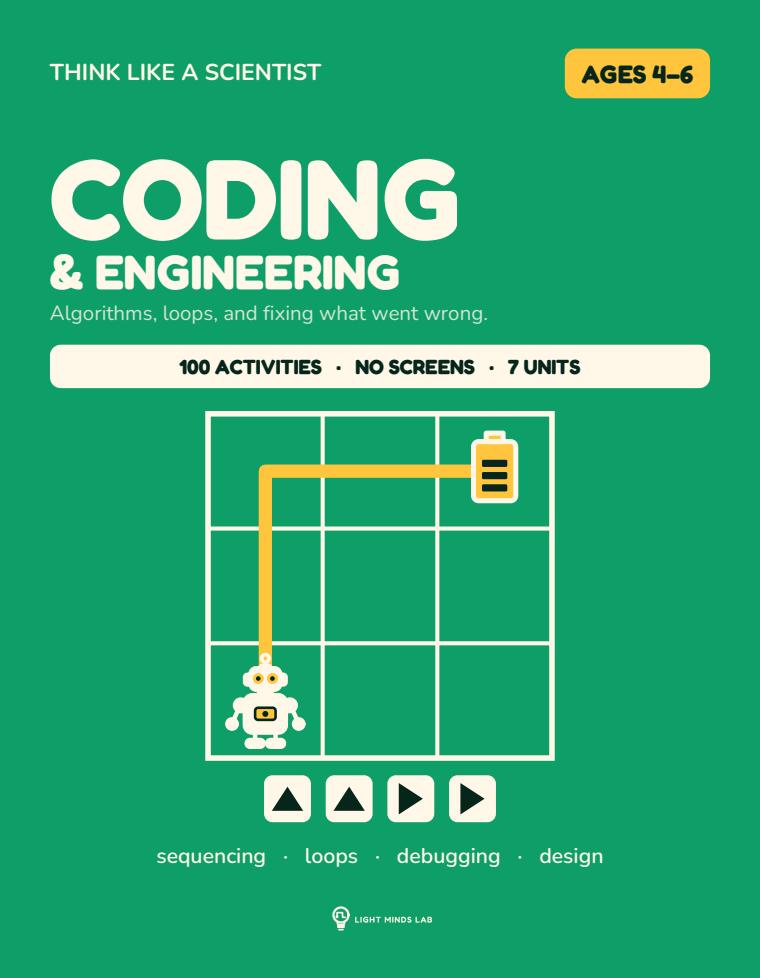
Give the child a grid, a robot on it, and a code, say → → ↑. They trace where the robot ends up. Reading comes before writing, the same as with text.
The most useful thing you can do here costs nothing: be the robot. The child reads their code aloud and you run it exactly, including the step that is wrong. Do not correct as you go. Walk into the wall.
3. Writing a code of their own
Now reverse it. The path is drawn on the grid, and the child writes the arrows that produce it. This is the first time they have written instructions for someone else, and it is a big moment for a five-year-old.
4. Loops
Show a code with the same thing four times: → → → →. Then show the short way. A loop is not an abstract idea at this age. It is a shortcut, and children like shortcuts.
5. Conditions
"If it is raining, take the umbrella. If not, take the hat." Conditionals work at this age as long as they stay in the child's world and stay binary. Two branches, both concrete.
6. Debugging
Give them a code that does not work. The robot ends up in the wrong square, and exactly one arrow is wrong. The child finds it.
This is the unit that matters most and the one most curricula skip. A child who learns that a broken thing has a findable cause, rather than that broken means failed, has picked up something much larger than coding.
What to look for, rather than what to check
The answer on the page is the least interesting output. Watch for:
- Do they trace with a finger rather than guessing? That is simulation, and it is the core skill.
- Do they count squares out loud? That puts the working memory outside their head, which is a good sign.
- When it is wrong, do they re-run from the start or poke at the end? Re-running from the start is how debugging works.
Things that do not help
- Speed. There is no timer in anything worth doing here.
- Correcting a wrong arrow before the child has run the code. The run is where the learning is.
- Explaining the word "algorithm." They will meet it later and it will mean something. At five, "the steps in order" is the whole concept, and it is a better definition than most adults could give.