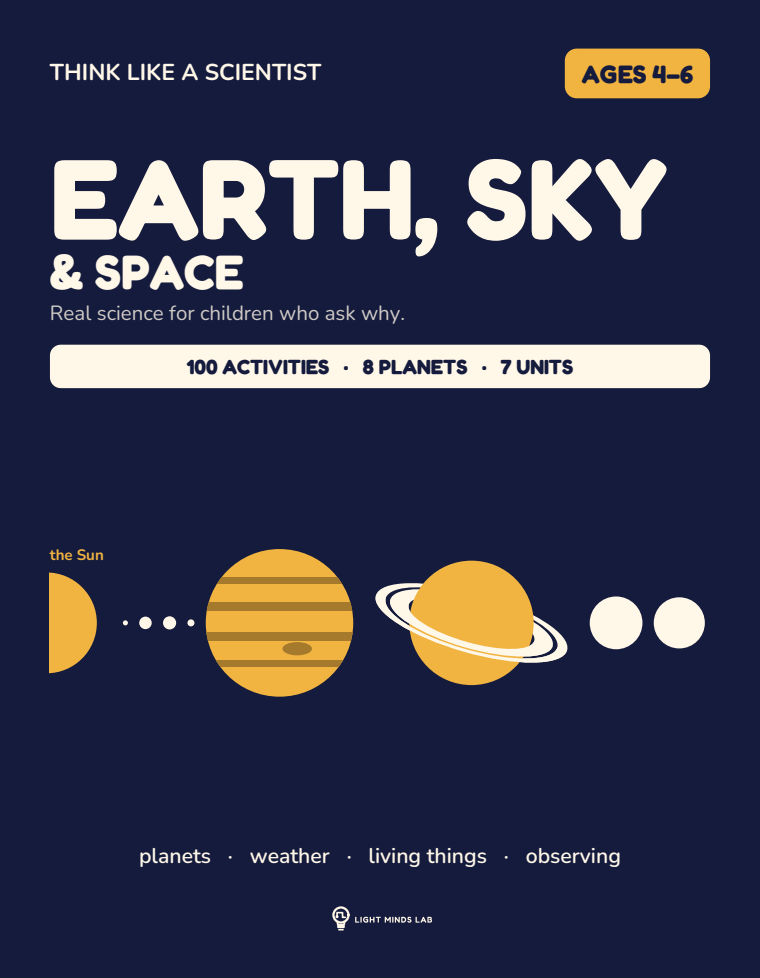
Children who ask about space ask hard questions early, and they remember the answers. That makes accuracy worth more at this age than at almost any other, because a misconception picked up at five takes years to dislodge.
Children's space material repeats a small set of errors. They are all avoidable.
The eight planets, in order
Mercury, Venus, Earth, Mars, Jupiter, Saturn, Uranus, Neptune.
The common mnemonic, My Very Educated Mother Just Served Us Noodles, still works and no longer needs a ninth word. Say the order enough times that it becomes a chant rather than a fact to be recalled. It is the kind of thing a five-year-old memorizes without effort and an adult labors over.
Pluto
The accurate and complete answer for a five-year-old: Pluto is a dwarf planet. It is real, it is out there, it is smaller than our moon, and there are several others like it.
What not to do is teach it as a sad story about demotion. Pluto did not lose anything. We found more objects like it and needed a better word for the group. That is a fine thing to tell a child about how science works: sometimes we learn more and change what we call things.
The four errors worth avoiding
1. Planets in a neat row, evenly spaced, all the same size. Almost every children's illustration does this. The solar system is mostly distance. If you show the planets in a line, at least make the sizes honest. Jupiter is enormous, Mercury is tiny, and Earth is one of the small ones.
Do not scale Mercury up so it is visible. Let it be the small dot it is. That is the fact.
2. The moon phases caused by Earth's shadow. This is the most persistent astronomy misconception and it is usually learned young. The phases come from which part of the lit half we can see as the moon goes around us. Earth's shadow on the moon is an eclipse, which is a different and rarer thing.
The easiest demonstration costs nothing. Use a lamp in a dark room, a ball on a stick, and the child turning slowly in place holding the ball out in front of them. The lit part of the ball changes shape as they turn. That is the mechanism, and a five-year-old can see it.
3. Seasons caused by distance from the sun. They are not. Earth is closest to the sun in January. Seasons come from the tilt. For this age, "the part of Earth we live on leans toward the sun in summer and away in winter" is enough, and it is true.
4. Stars as five-pointed. Not worth fighting. The symbol is everywhere and children need it for drawing. It is worth saying once that real stars are balls like our sun, and that our sun is a star that happens to be close.
What "close" means
Scale is the most challenging idea here, and the easiest one to do with your feet. Walk it. Put the sun at one end of a park, take fifteen paces for Mercury, and keep going. You will run out of park before you reach Neptune.
The lesson is not the numbers. It is running out of park.
Start with the sky you can see
Everything above is better after the real thing. Before any diagram of moon phases, go and look at the moon tonight, and again in four days, and draw both. Before weather pages, record the weather for a week with a mark per day, which is also the first data work most children ever do.
Observation first, page second. The page is where you record what you noticed, not a replacement for looking.
A note on what we print
The planets in our books are drawn at true relative size on the line-up, in the correct order, with current NASA naming, and Pluto named as a dwarf planet where it appears at all.
A four-year-old cannot check any of that. A seven-year-old can.