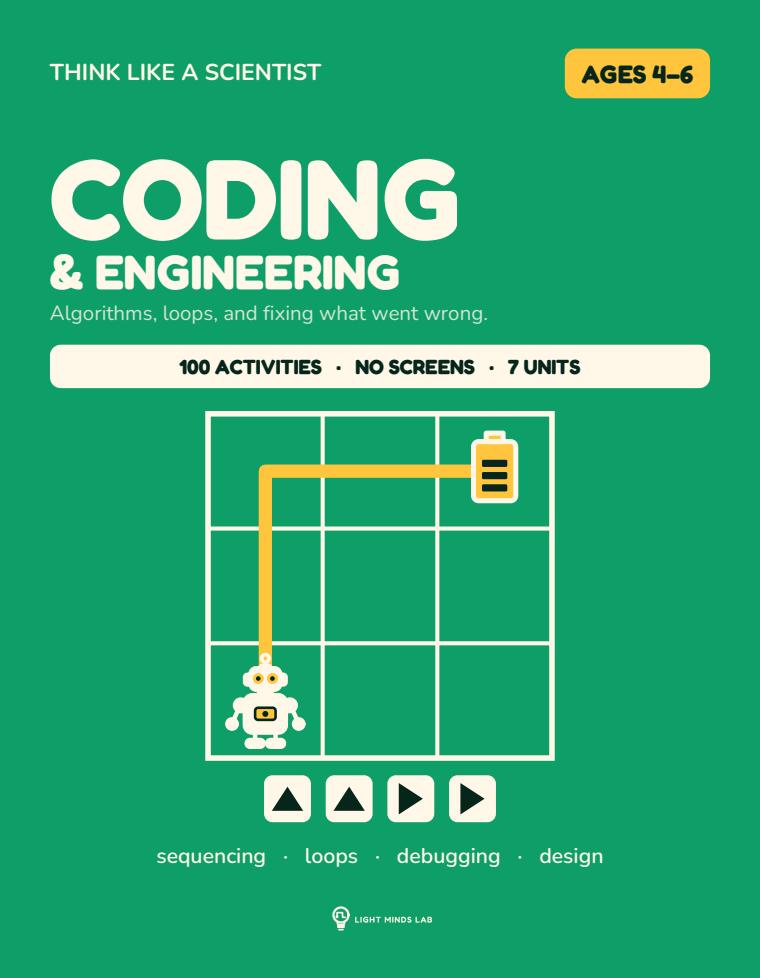
Six bonus coding sheets, not in the book
Six sheets in the book's formats with grids and codes the book does not print: read a three-arrow code, predict whether a five-arrow code lands, write the code for a drawn path, pick the one of three codes that works, find the wrong step in five, and shorten six arrows to two loops. None of them is a page of the book. Every code was run by the same simulator the book uses, so what the sheet says lands, lands.
US Letter · 6 pages · black and white · no signup
What is on the sheets
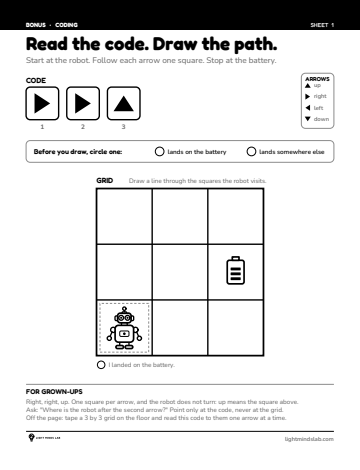
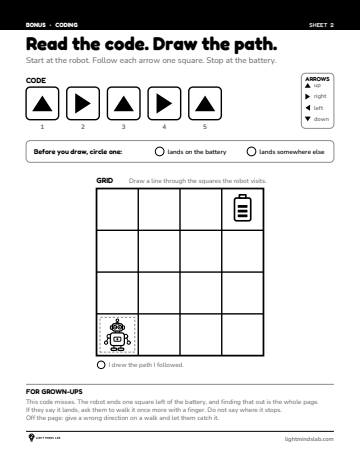
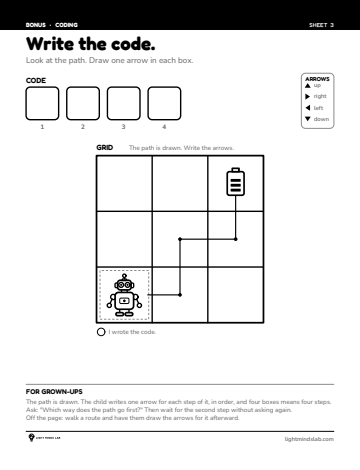
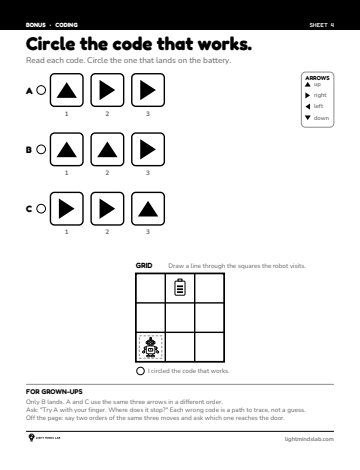
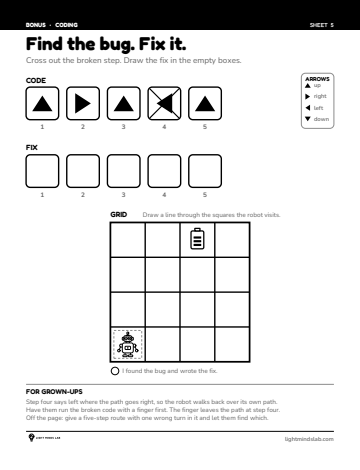
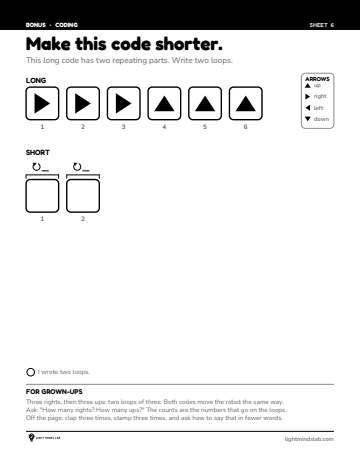
Print at actual size (100%), not "fit to page". The target sizes on these pages are chosen for a particular age of hand, and scaling shrinks them.
Using them well
Circle the prediction first
On the two read-the-code sheets the child circles where the robot will land before drawing. Sheet 2 misses, and finding that out is the page.
Trace every code on sheet 4
Three codes, one grid. Have them run A, B and C with a finger. Two of the three stop one square from the battery.
Do not point at step four
On the bug sheet, ask which steps they have checked. The finger leaves the path at step four, and they should be the one to notice.
Questions
What is bonus material?
Sheets made for this site with the tools that made the book, and not printed in it. They carry the Light Minds Lab mark and this address instead of a page number.
Are these in the book?
No. The formats, the robot, the grid and the arrow key are the book's. Every code and grid here is new.
What age are they for?
Four to six, like the book. Sheets 1 and 3 suit a four-year-old; the bug and the loops are for five and six.
Do these need a computer?
No. Nothing on them connects to anything. Arrows, a grid, a pencil.
Guides that go with these
Unplugged coding for preschoolers: where to start
Four ideas underneath every programming language, none of which need a computer, and the order a four-year-old can meet them in.
Choosing a bookWhich activity book for which age: 3, 4, 5 and 6
The maze book lists from three. The other three list from four. Here is what sits inside those ranges: the book for each age, the page to open it at, and the sign that says move up.
For grown-upsHow to sit beside a child doing a worksheet
The most challenging part of an activity book is not on the page. It is sitting there while a four-year-old gets it wrong.
How we make themWhy our activity books are printed in black and white
The research behind it, the one finding that argues against it, and what the child gets in return.
Where these came from
These 6 are not in the book.
Sequences, loops, conditionals and debugging, written in arrows on paper. No app, no tablet, no login. A locked symbol set of arrows and a grid. The child reads a code and traces it, then writes a code of their own, then shortens it with a loop, then finds the one wrong step in a code that does not work.