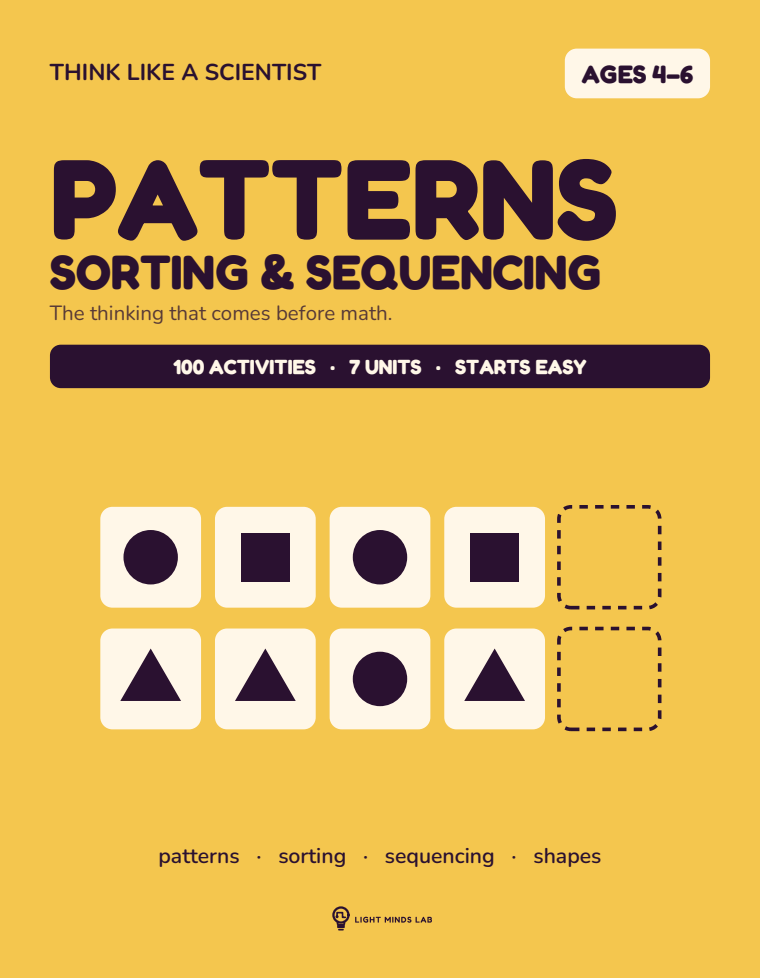
Six bonus pattern and sorting sheets, not in the book
Six sheets in the book's six formats, with pictures and rules the book does not print: sort flies from floats, cross out the one that did not grow, continue star-star-moon, fill two gaps in a three-picture pattern, put an egg's story in order, and graph cats, dogs and birds. None of them is a page of the book.
US Letter · 6 pages · black and white · no signup
What is on the sheets
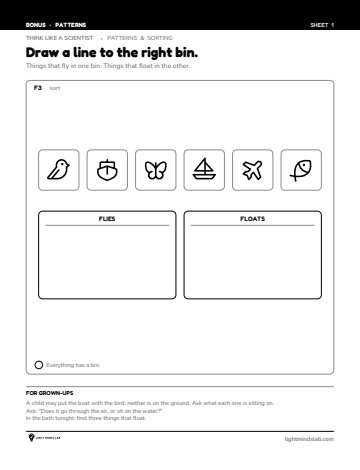
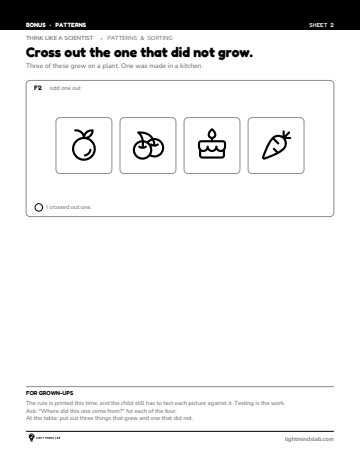
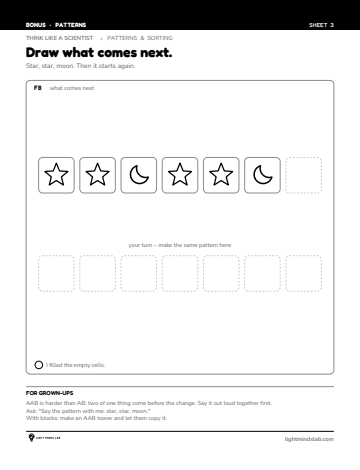
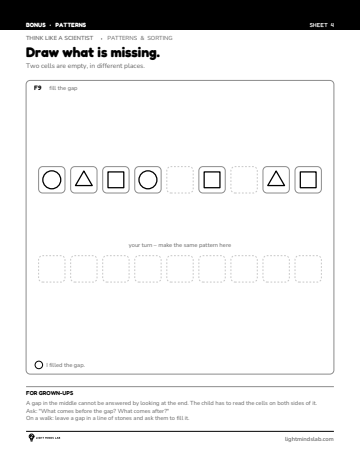
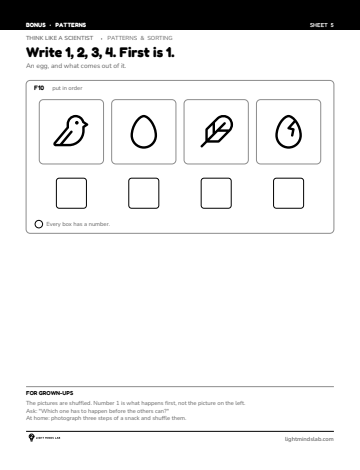
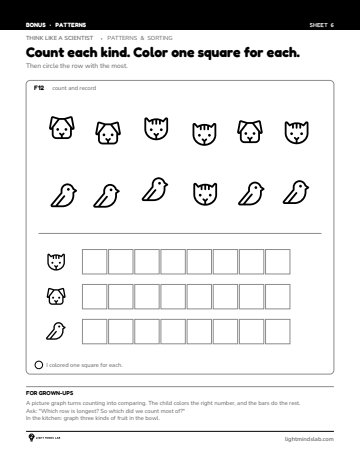
Print at actual size (100%), not "fit to page". The target sizes on these pages are chosen for a particular age of hand, and scaling shrinks them.
Using them well
Say the pattern out loud
The AAB sheet is the hard one. A child who says star, star, moon while pointing finds the next cell; a child who only looks often does not.
Let them find the rule
On the sort and the odd-one-out sheets, the rule is printed. Ask them to say it in their own words before they draw a line.
Count before coloring
On the graph sheet, have them touch each animal as they count it. The bars then do the comparing.
Questions
What is bonus material?
Sheets made for this site with the tools that made the book, and not printed in it. They carry the Light Minds Lab mark and this address instead of a page number.
Are these in the book?
No. The formats are the book's, with its picture set and its grown-up notes, but each activity here is new. The book's 100 activities are the book's.
What age are they for?
Four to six, like the book. The sort and the odd one out suit a four-year-old; the two-gap pattern and the graph are for five and six.
Do I need to sign up or pay?
No. One PDF, six pages, no email address.
Guides that go with these
AB, ABC, AABB: what preschool pattern work teaches
Most pattern worksheets stop at AB and stay there. The progression past it is where the mathematics is.
Choosing a bookWhich activity book for which age: 3, 4, 5 and 6
The maze book lists from three. The other three list from four. Here is what sits inside those ranges: the book for each age, the page to open it at, and the sign that says move up.
For grown-upsHow to sit beside a child doing a worksheet
The most challenging part of an activity book is not on the page. It is sitting there while a four-year-old gets it wrong.
How we make themWhy our activity books are printed in black and white
The research behind it, the one finding that argues against it, and what the child gets in return.
Where these came from
These 6 are not in the book.
Matching, sorting, seriation, and patterns from AB to growing. This is the thinking a child needs before arithmetic makes sense. Seven units, each opening at its own easiest version: same and different, sorting by one rule then two, ordering by size, AB through AABB and growing patterns, sequencing events, shape and position, then challenges that combine them.