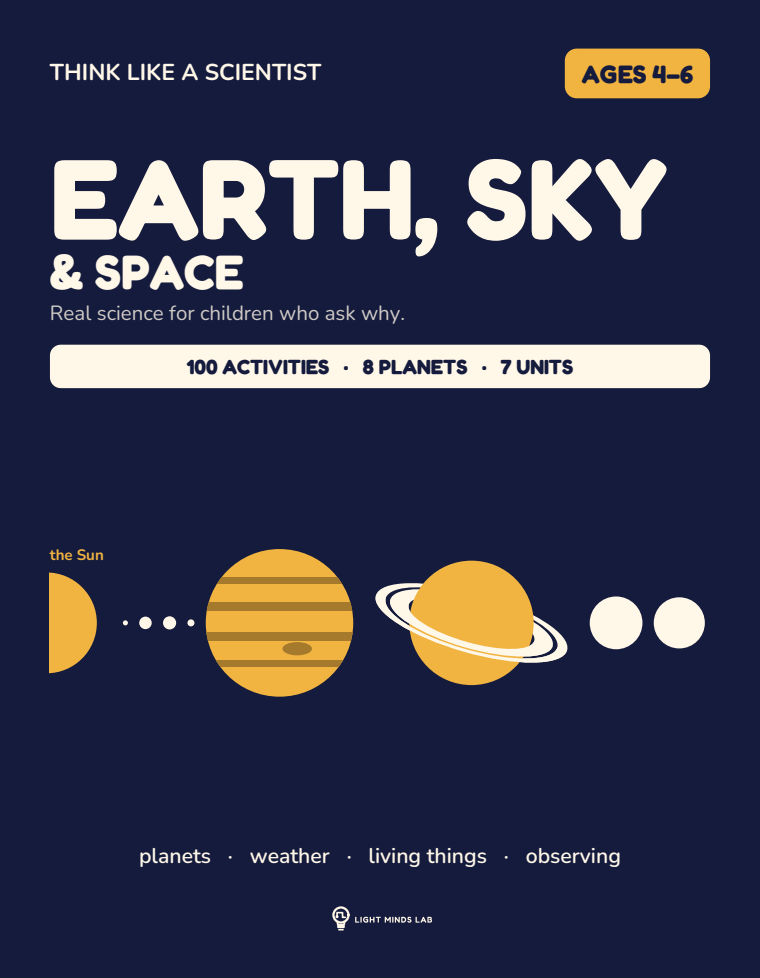
Six bonus Earth, sky and space sheets, not in the book
Six sheets in the book's formats with content the book does not print: sort weather from what you wear for it, circle what is in the night sky, count eight snowflakes, put a rocket's trip in order, decide whether the Earth or the Sun is bigger, and graph a week of skies. None of them is a page of the book. Each carries one fact for the grown-up that is true and one thing to look for outside.
US Letter · 6 pages · black and white · no signup
What is on the sheets
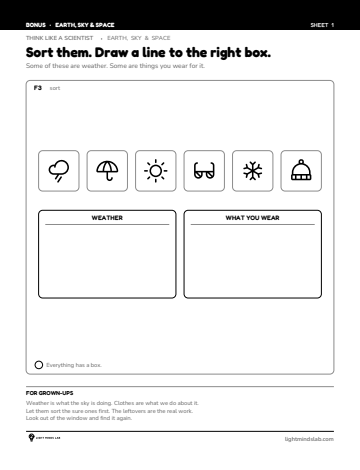
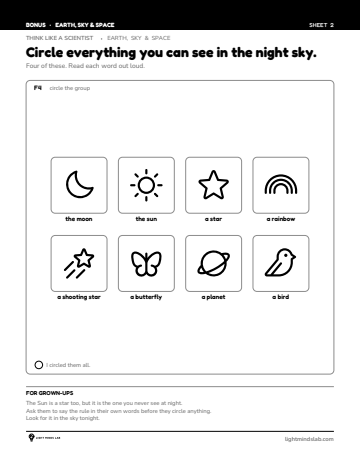
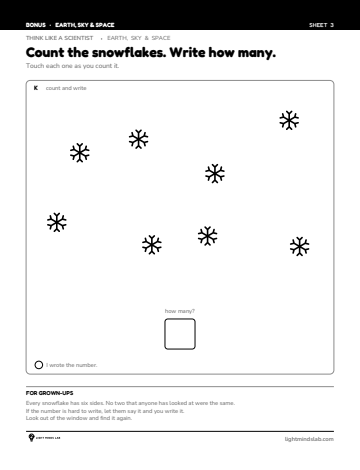
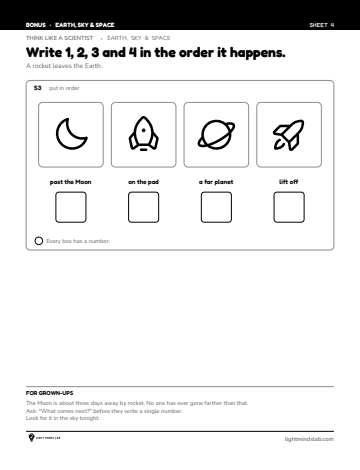
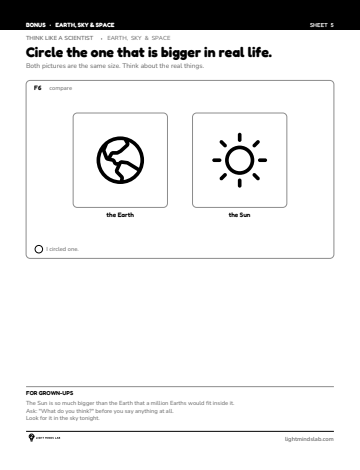
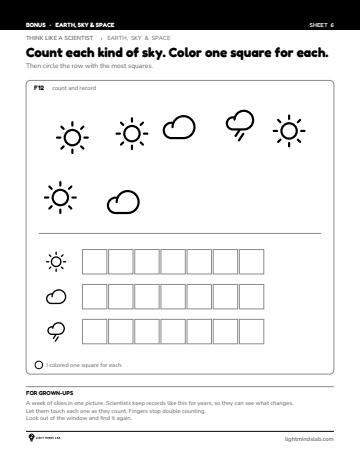
Print at actual size (100%), not "fit to page". The target sizes on these pages are chosen for a particular age of hand, and scaling shrinks them.
Using them well
Do the graph across a week
The sky graph is drawn with seven days of weather already on it. Do it once as printed, then keep your own on the back for a real week.
The Sun is a star
The night-sky sheet has the Sun as a distractor. A child who asks why it is not circled has understood the page.
Same size is the trick
The Earth and the Sun are drawn the same size on purpose. The child has to know, not look.
Questions
What is bonus material?
Sheets made for this site with the tools that made the book, and not printed in it. They carry the Light Minds Lab mark and this address instead of a page number.
Are these in the book?
No. The formats and the picture set are the book's, and every activity here is new. The book's 100 activities are the book's.
What age are they for?
Four to six, like the book. The sort and the count suit a four-year-old; the rocket sequence and the graph are for five and six.
Do I need to sign up or pay?
No. One PDF, six pages, no email address.
Guides that go with these
Teaching the solar system to a 4–6 year old, accurately
Young children can handle accurate astronomy. What they cannot undo easily is a misconception learned at five.
Choosing a bookWhich activity book for which age: 3, 4, 5 and 6
The maze book lists from three. The other three list from four. Here is what sits inside those ranges: the book for each age, the page to open it at, and the sign that says move up.
For grown-upsHow to sit beside a child doing a worksheet
The most challenging part of an activity book is not on the page. It is sitting there while a four-year-old gets it wrong.
How we make themWhy our activity books are printed in black and white
The research behind it, the one finding that argues against it, and what the child gets in return.
Where these came from
These 6 are not in the book.
Day and night, weather, land and water, living things, the moon and stars, and the eight planets, drawn accurately. Eight planets, correct order, true relative scale on the line-up, current NASA naming, and Pluto named as a dwarf planet where it appears at all. A four-year-old cannot check this. A seven-year-old can.