Free printable mazes for kindergarten
Six mazes drawn with the same generator as the book, at its Levels 3 to 5, and printed in none of it: a 4×4 and a 5×5 with a choice or two at each junction, two 6×6 grids and a 7×7 with dead ends a few squares deep, and an 8×8 whose dead ends run longer than the true path. Balloon to cloud, moped to road, fish to anchor, train to tent, car to house, boat to lighthouse. Each has the book's marks key, the check line the child ticks, and three notes for the grown-up.
US Letter · 6 pages · black and white · no signup
What is on the sheets
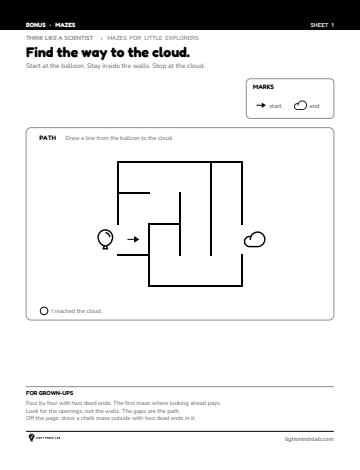
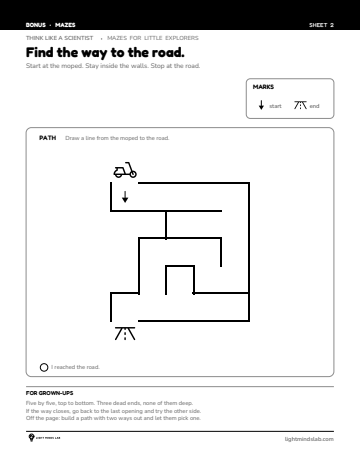
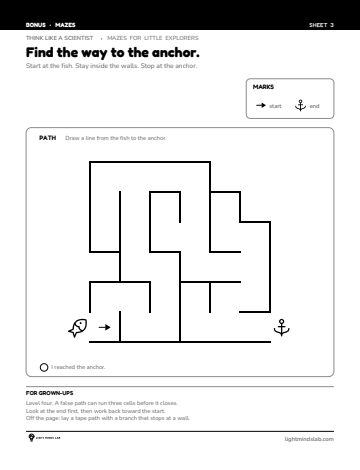
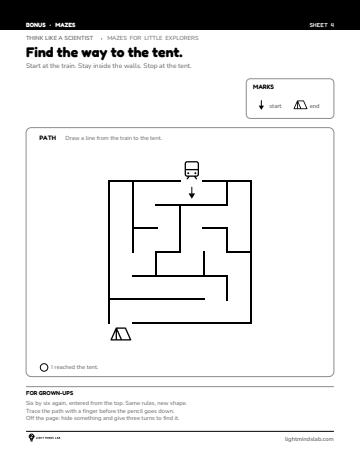
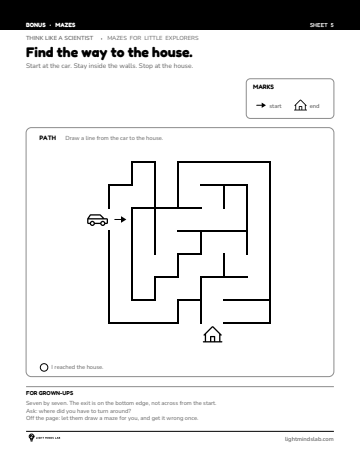
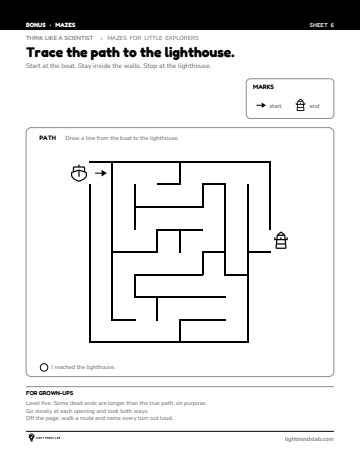
Print at actual size (100%), not "fit to page". The target sizes on these pages are chosen for a particular age of hand, and scaling shrinks them.
Using them well
Look before the pencil moves
Ask the child to find the way with a finger first. Looking ahead of the pencil is the skill these grids teach, and a finger is free to be wrong.
Let the dead end happen
The 6×6 and 7×7 mazes have dead ends a few squares deep on purpose. Noticing you are stuck and going back is the point. Say nothing until they ask.
Too easy is a sign too
A child who finishes all six without a pause is ready for Level 5 in the book, which runs up to 11×11.
Questions
What age are these mazes for?
Four and five. They are drawn at Levels 3 to 5 of a book that lists for ages 3 to 5. A four-year-old who has done simple mazes will manage the 4×4 and 5×5 grids; the 6×6 and up, with dead ends, are for five. A six-year-old who has never done a maze can start here too.
How are these different from the preschool set?
The preschool set is four pages of the book, from a single channel with no wrong turns up to a 9×9. This set is six new mazes that all have junctions, and the second half has dead ends that need backtracking. None of these six is in the book.
What is bonus material?
Sheets made for this site with the tools that made the book, and not printed in it. They carry the Light Minds Lab mark and this address instead of a page number, because they belong to no book. The mazes come from seeds the book does not use, with start and end pictures the book does not pair.
How should I print them?
Letter paper, black and white, at 100 percent rather than fit to page. The corridors are 0.38, 0.32 and 0.28 inches wide by design, and scaling shrinks them. A pencil is fine at this level.
Guides that go with these
Mazes by age: what a 3, 4, 5 and 6-year-old can do
A maze is three separate skills stacked on top of each other, and children pick them up years apart. Here is which maze belongs to which age.
Fine motorPencil grasp by age, and what helps
Grasp develops on its own schedule. What you can change is what the hand gets to practice, and the size of what you ask it to do.
Choosing a bookWhich activity book for which age: 3, 4, 5 and 6
The maze book lists from three. The other three list from four. Here is what sits inside those ranges: the book for each age, the page to open it at, and the sign that says move up.
For grown-upsHow to sit beside a child doing a worksheet
The most challenging part of an activity book is not on the page. It is sitting there while a four-year-old gets it wrong.
How we make themWhy our activity books are printed in black and white
The research behind it, the one finding that argues against it, and what the child gets in return.
Where these came from
These 6 are not in the book.
One maze per page, from a single wide channel a three-year-old can finish to an 11×11 grid with real dead ends. The difficulty climbs across this book. Maze 1 is a wide corridor with no branches. Maze 100 is an 11×11 grid, 121 cells, with no help in any of them. Every step in between is a page.