Free printable moon phases worksheets
Six sheets on the Moon: match each moon shape to its twin, number four phases in the order the Moon grows, circle the full moon by name, draw the Moon on five nights in a row, count the crescents, halves and full moons and color a graph, then count the stars in a patch of sky. The five-night sheet is the one that matters; the others are better after it. Drawn with the book's tools, and in none of it.
US Letter · 6 pages · black and white · no signup
What is on the sheets
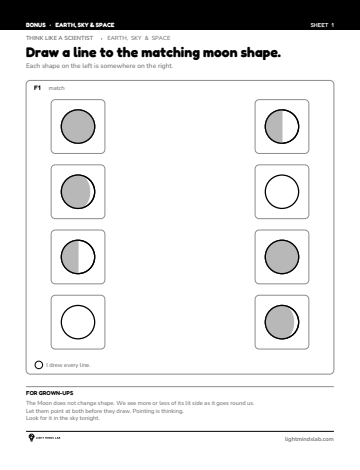
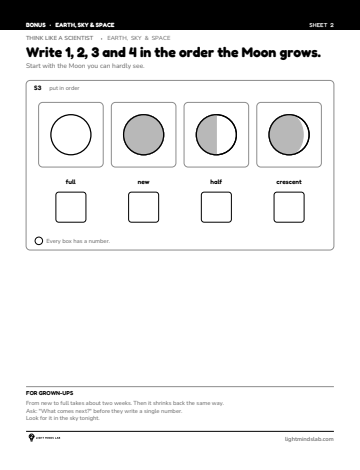
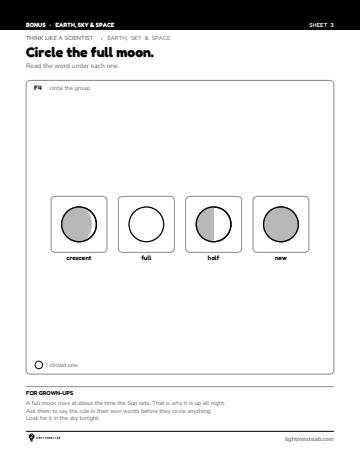
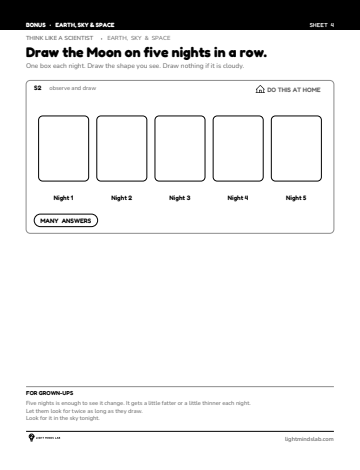
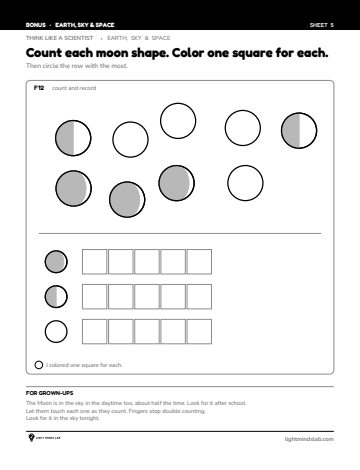
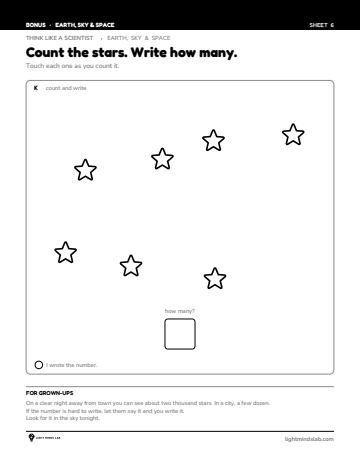
Print at actual size (100%), not "fit to page". The target sizes on these pages are chosen for a particular age of hand, and scaling shrinks them.
Using them well
Look first, then draw
The five-night sheet is the reason the set exists. Look at the Moon tonight, draw it, and look again tomorrow. Five drawings in a row show a phase changing better than any diagram.
Say where the light comes from
The Moon makes no light of its own; it reflects the Sun's. That one sentence, said often, heads off the most common misconception in children's astronomy.
A lamp and a ball
A lamp in a dark room, a ball on a stick, and the child turning slowly in place. The lit part of the ball changes shape as they turn. That is the mechanism, and a five-year-old can see it.
Questions
What causes the phases of the Moon?
Which part of the Moon's lit half we can see as it goes around us. Earth's shadow on the Moon is an eclipse, a different and rarer thing. The lamp and ball under the tips shows it in a minute.
What age are these moon worksheets for?
Four to six. Matching moon shapes and circling the full moon suit a four-year-old. Numbering the phases in order is five or six. The five-night sheet works at any age with an adult to go outside with.
Which phases are on the sheets?
New moon, crescent moon, half moon and full moon, named that way on the page. Waxing, waning and gibbous come later; at this age the job is noticing that the shape changes and that it changes in an order.
Do I need to sign up or pay?
No. One PDF, six pages, no email address. They are not pages of the book: they are six new activities drawn by the book's renderer, with our mark and this address where a page number would be.
Guides that go with these
Teaching the solar system to a 4–6 year old, accurately
Young children can handle accurate astronomy. What they cannot undo easily is a misconception learned at five.
Choosing a bookWhich activity book for which age: 3, 4, 5 and 6
The maze book lists from three. The other three list from four. Here is what sits inside those ranges: the book for each age, the page to open it at, and the sign that says move up.
For grown-upsHow to sit beside a child doing a worksheet
The most challenging part of an activity book is not on the page. It is sitting there while a four-year-old gets it wrong.
How we make themWhy our activity books are printed in black and white
The research behind it, the one finding that argues against it, and what the child gets in return.
Where these came from
These 6 are not in the book.
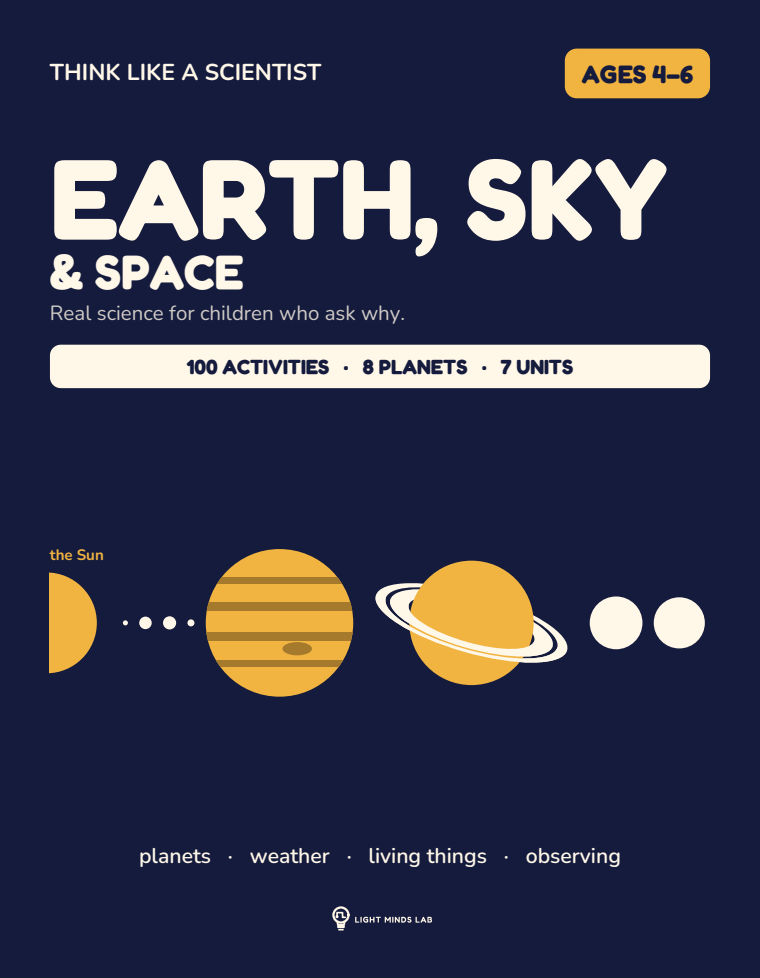
Day and night, weather, land and water, living things, the moon and stars, and the eight planets, drawn accurately. Eight planets, correct order, true relative scale on the line-up, current NASA naming, and Pluto named as a dwarf planet where it appears at all. A four-year-old cannot check this. A seven-year-old can.