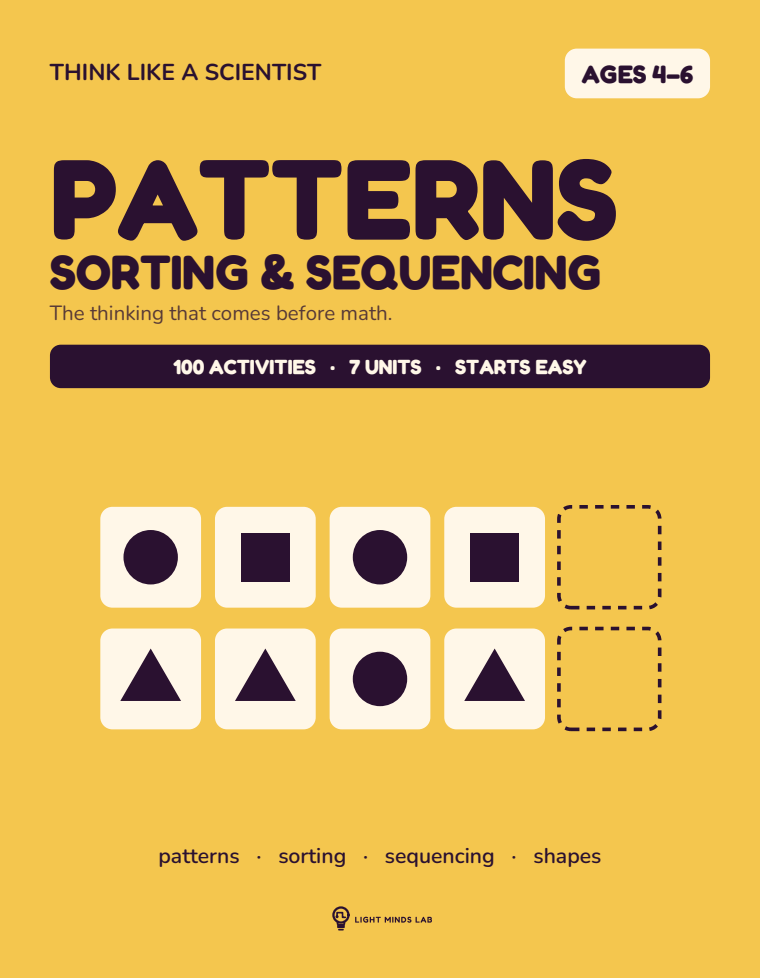
Free printable sorting worksheets
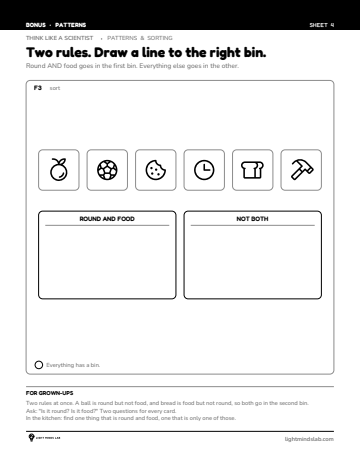
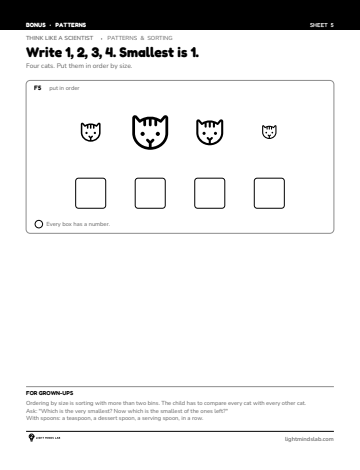
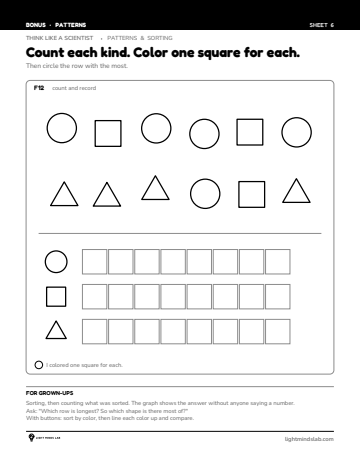
Six sheets in the order classification develops: cross out the one that does not go in water, sort what is in the sky from what grows in the ground, circle everything you can wear, sort by two rules at once (round and food), put four cats in order by size, then count circles, squares and triangles and color a graph. The two-rule sheet is the one that shows whether the child has the idea. Drawn with the book's tools, and in none of it.
US Letter · 6 pages · black and white · no signup
What is on the sheets
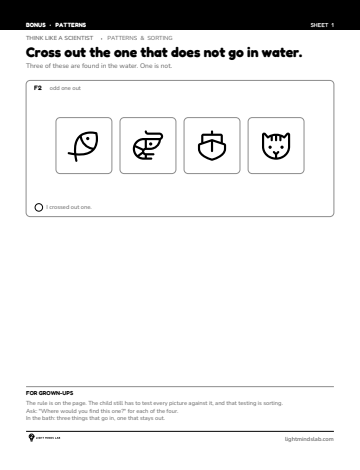
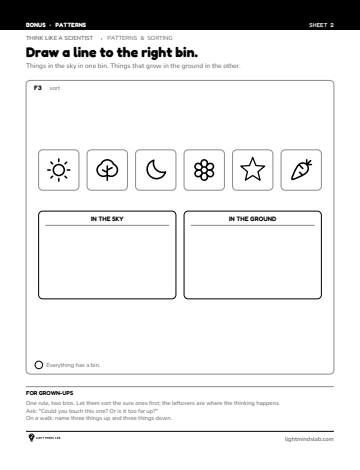
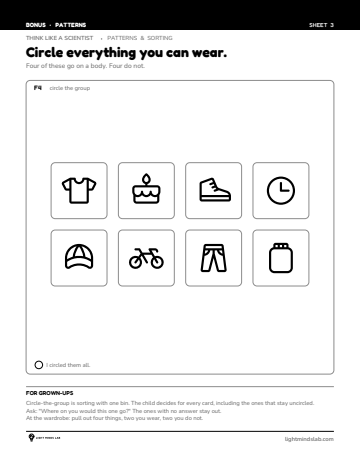
Print at actual size (100%), not "fit to page". The target sizes on these pages are chosen for a particular age of hand, and scaling shrinks them.
Using them well
Ask for the rule
"Why does that one go there?" A child who can say the rule has sorted. A child who cannot has matched pictures, and the two look the same on paper.
Re-sort the same pile
After the sheet, put a handful of buttons on the table and ask for a sort. Then ask for a different sort of the same buttons. Re-sorting is the test that predicts the rest.
Two rules is a real step
Round and food, in one bin. Everything else in the other. A ball is round and not food, and bread is food and not round. Expect wrong answers here from children who breezed through the single-rule sheets.
Questions
What age are these sorting worksheets for?
Four to six. Odd one out and circle the group are fine at four. Sorting into bins by one rule is four or five, sorting by two rules at once is five or six, and the graph sheet works at any of them once the child can count.
Why does sorting matter?
Before a child can find the unit of a pattern they need to say what makes two things the same thing. That is classification, and sorting, seriation and patterning together are the algebraic-thinking strand of early math.
Do the sheets need scissors or objects?
No. Everything is drawn, circled or crossed out on the page. Objects come after: the sheet is a record of a sort that is better done first with buttons or socks.
Do I need to sign up or pay?
No. One PDF, six pages, no email address. They are not pages of the book: they are six new activities drawn by the book's renderer, with our mark and this address where a page number would be.
Guides that go with these
AB, ABC, AABB: what preschool pattern work teaches
Most pattern worksheets stop at AB and stay there. The progression past it is where the mathematics is.
Choosing a bookWhich activity book for which age: 3, 4, 5 and 6
The maze book lists from three. The other three list from four. Here is what sits inside those ranges: the book for each age, the page to open it at, and the sign that says move up.
For grown-upsHow to sit beside a child doing a worksheet
The most challenging part of an activity book is not on the page. It is sitting there while a four-year-old gets it wrong.
How we make themWhy our activity books are printed in black and white
The research behind it, the one finding that argues against it, and what the child gets in return.
Where these came from
These 6 are not in the book.
Matching, sorting, seriation, and patterns from AB to growing. This is the thinking a child needs before arithmetic makes sense. Seven units, each opening at its own easiest version: same and different, sorting by one rule then two, ordering by size, AB through AABB and growing patterns, sequencing events, shape and position, then challenges that combine them.